
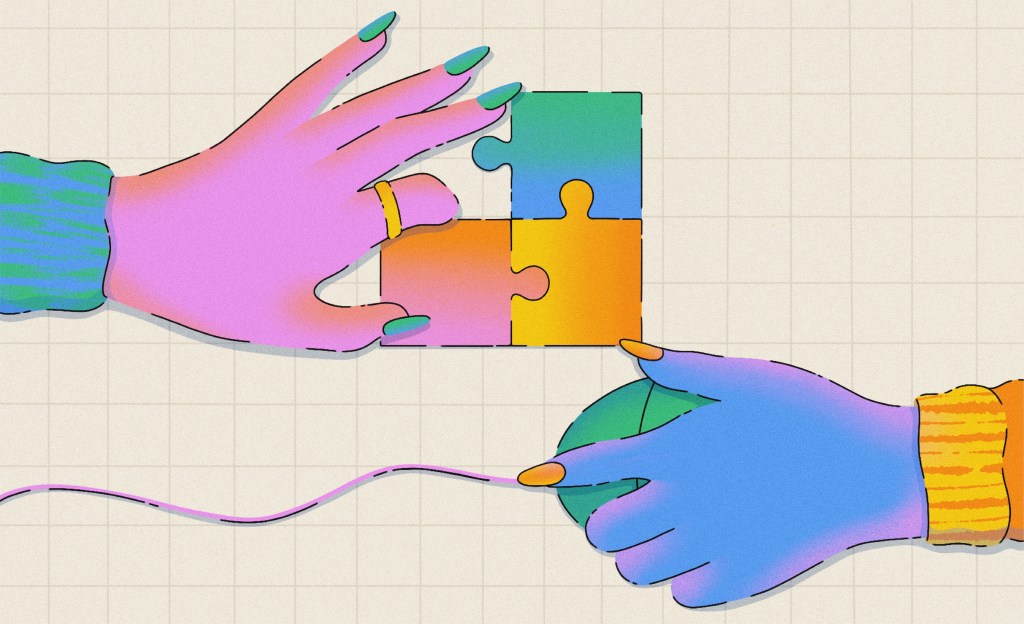
Illustration by Kris Russell. Learn more about our illustrators.
Mindsets of Public Design Bureau: Embracing Empathy
What’s the mindset
Empathy is a core human-centered mindset that pushes us to listen to, center, and attempt to understand other people’s lives and experiences. The definition of empathy is “the ability to sense other people’s emotions, coupled with the ability to imagine what someone else might be thinking or feeling” (UC Berkeley Greater Good Institute). In design, we seek to build empathy with a wide variety of people who are directly impacted by a project in order to include their perspectives and priorities in design decision making. While we will never be able to fully know someone else’s inner world, by creating structures and methods for both learning and deciding with others we build ways to get to deeper understanding together.
Why it’s important
Empathy helps us make things that actually work for the contexts and people we’re hoping to serve. When we make decisions and create things without embracing empathy, we end up creating things that are shaped by our experiences alone. Often this narrow, self-centered focus leads to results that aren’t effective or valuable for others – because it doesn’t reflect their realities or priorities. It can feel tempting to just build on what we know when we’re immersed in a topic or problem, or when there’s a high sense of urgency for action. Cultivating a beginner’s mindset can be a first step, but the people who are directly impacted are able to bring depth about how, when, where, who, and most critically, why, they do what they do. If the people most impacted are not involved in designing something that works for their needs, a project risks creating a solution for the wrong problem or not fostering the trust and buy-in required for people to engage with something new.
Embracing empathy in the real world
Many people are familiar with the book “The Five Love Languages” by Gary Chapman, which outlines five general ways that people express and experience love, such as quality time or gifts. Liz says, “I have different giving and receiving love languages, and they are different languages than what my spouse uses. For example, I love giving gifts, but receiving them isn’t as important to me. My spouse doesn’t rank gifts highly at all. The love languages framework has been a helpful tool for me to build empathy about what’s meaningful to my spouse, and I can think about ways to demonstrate my love that matter to both of us.”
In the book, Chapman explains that learning about someone else’s love language requires observing the ways they express and respond to gestures of love. This process of observing and asking questions is a process of empathizing, which can be used in combination with an iterative approach to figuring out the best ways to show love to those you care about.
Embracing empathy in design
Designers commonly think about the ‘empathy’ part of the design process as early exploratory research, when we’re trying to understand the context and experience of others, or during evaluative feedback when we’re looking to understand how people would use specific ideas or possibilities. However, empathy should be present in every aspect of the design process, from designing worksessions through the process of change and implementation.
How we cultivate empathy
Empathy is an innate human characteristic, but we don’t always have as many chances to meaningfully practice empathy in action as we might like. A few things we do to keep empathy top-of-mind include:
- Put people with direct lived experience in the position of making decisions whenever possible. We love working on co-creation projects where the people who are directly impacted by design decisions are themselves designing the systems, tools, and experiences. Then, their experiences aren’t filtered by our biases and they can bring their full nuanced understanding to each decision.
- Use a range of different methods and approaches to understand the experiences of others. To build empathy, you need to talk to people, experience real contexts, and physically be present. We love to also expand our understanding by adding additional approaches like reading novels, exploring related social media, and observing specific environments.
- Recognize your assumptions and be prepared to have them questioned. Building empathy can be challenging because you learn that what you’ve assumed is wrong! We like to start by exposing our assumptions, and when possible, where they came from. This helps us support each other in letting assumptions go when they are questioned or contradicted by what we learn.
- Practice curiosity throughout your life. In many ways, empathy is an open-hearted curiosity about other people’s lives. You can practice with everyone you know, asking genuine, open-ended questions and learning about their lives outside the context of design.
Where do you use empathy? How have you cultivated it? Tell us more about how you embrace empathy in the comments, or send us a note at hello@publicdesignbureau.com.


One thought on “Mindsets of Public Design Bureau: Embracing Empathy”