

Illustration by Bob Hansman. Learn more about our illustrators.
Mindsets of Public Design Bureau: Creativity
What’s the mindset
Creativity as a mindset is using imagination (and some suspension of disbelief) to solve problems, address opportunities, and come up with ideas. Creativity is fundamentally tied to making things — deriving from the verb create — but it doesn’t necessarily mean that the mindset of creativity has to be applied only to physical things. Creativity can be part of processes, interactions, expression and more.
While we sometimes connect creativity to something new and novel, creativity does not necessarily mean complete originality. Often, creativity can come from seeing things that already exist from a new perspective or bringing disparate ideas into a relationship with each other. When the goal of bringing a creative mindset is to impact the world around us, the process gets to match up and refine the far-out ideas that come from our imaginations with practical constraints and applications. But creativity gives that rich fodder of what might be, imagining potential futures beyond the reality of the now.
Why it’s important
There are a lot of tricky and intractable challenges in the world, and a lot of opportunities to make things better (which could mean more just, more beautiful, less stressful, or even just smelling better) that we as a society do not take advantage of. Creativity is a core mindset that supports us making moves to address those challenges and opportunities. It allows us to imagine that things could be different and to move beyond the places where things may be stuck, unlocking the potential in the tools we have.
Creativity is also important because it’s a design mindset that everyone can activate. While we believe that everyone can manifest all of the mindsets of design, some others in the set often take specific skills, time, or patience (you might think about visual thinking, or embracing failure, as being ones that need some extra support for successful application). But within all of us already is a creative self that we can activate and unlock — and because ideas come from lots of places, and everyone can come up with a good idea, we end up with much better imaginings and outcomes when everyone is involved.
Embracing creativity in the real world
Annemarie loves to keep little bits and bobs around for all sorts of creative purposes — everything from the packing material that things were shipped in to partially-used paints to scraps of fabric and ribbons, all stashed in the supplies’ closet. On their own, each item isn’t much to look at, but as a collection her supplies serve as an invaluable prompt for everyday creativity. Whenever a household problem pops up, the supplies’ closet answers “We’ve got just the thing for that!” Friend’s board game missing an important piece? We’ve got the right sized dowel and shade of blue paint to make a spare. Need a toddler toy in a pinch? These cups of brightly colored puff balls will do the trick. Not sure what to wear to that costume party? Grab the bag of fake feathers to jazz up that dress. Left to its own devices, Annemarie’s imagination would come up with lots of other creative ideas, but they’d probably end up as just another item on the to-do project list (current waitlist: 3 months). But by letting her creativity be guided by what she already has on hand (and keeping many…many things on hand) she can move much more quickly from noticing a problem to thinking of an idea and finally to creating it with the perfect mix of this and that.
Embracing creativity in design
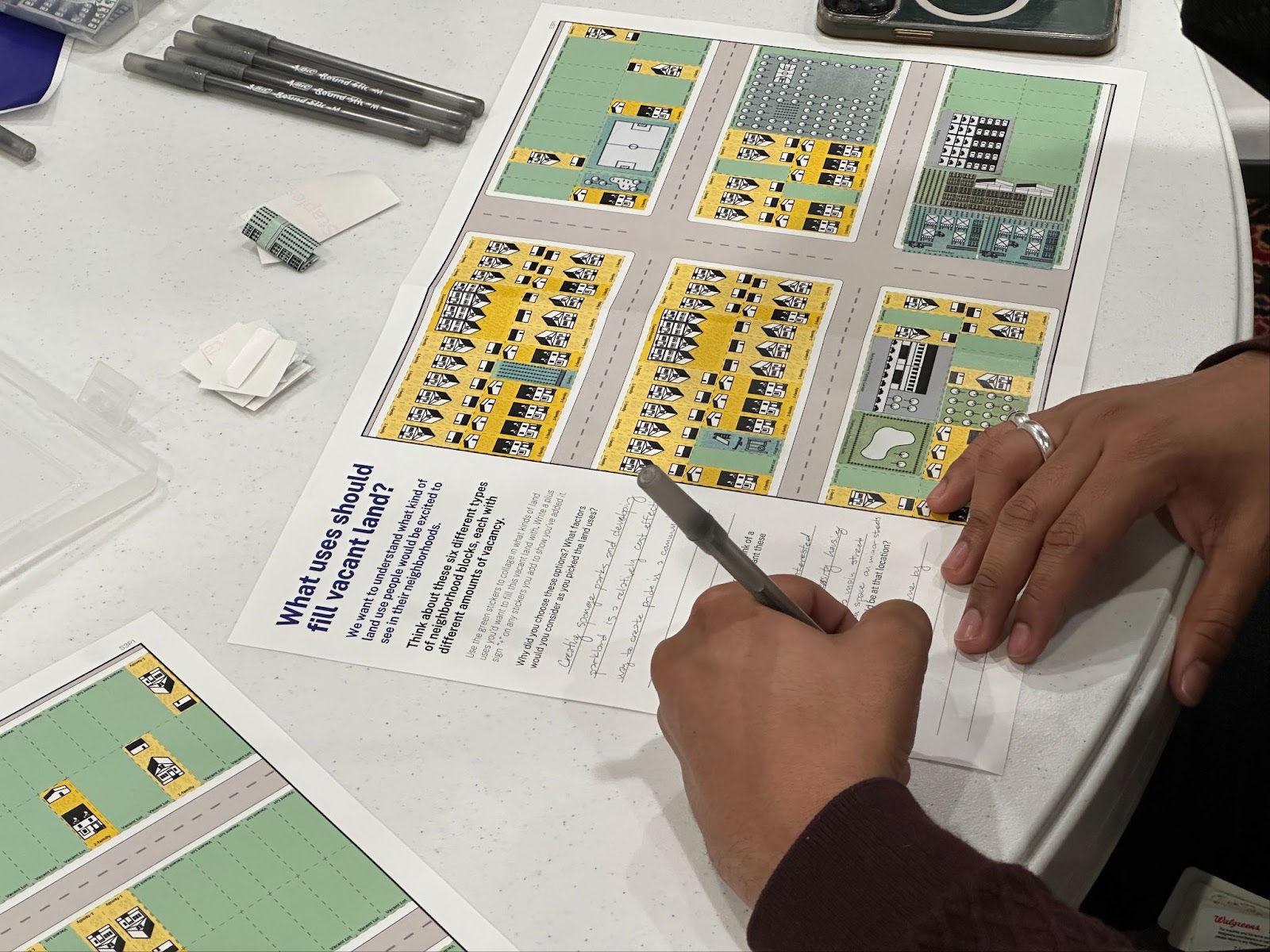
For us, creativity is an important part of the whole design process – from how we will learn from and with people to the implementation of ideas. Designing research and engagement activities is one of our favorite places to use creativity — frequently we know what we want to learn about, and we get to be creative with how that happens. We generate ideas for conversation prompts, tools to use, and activities that will be most exciting and relevant to the people we’re talking with. After we’ve come up with these ideas, then we assess for feasibility and implementation…allowing ourselves to be purely creative upfront and then later refine the ideas to fit our constraints.
Another place where creativity is a critical mindset in design is during prototyping and piloting. No matter how good an idea is at the onset, what will happen in reality and on the ground will raise new situations and questions that require adjustment, reevaluation, and iteration. Creativity is core to fueling that process, drawing from the available resources and being open to continue imagining new possibilities.
And of course, a key moment for creativity during the design process is during ideation, when we actually come up with ideas. However, creativity at this moment is not as simple as just coming up with the newest, wildest idea — it also means taking a close look at the things that we’ve done in the past that need revisiting, seeing what we can learn from others, and bringing together surprising but complimentary ideas. Read more about where ideas come from here.
How we cultivate creativity
There’s plenty on the internet about how to cultivate creativity, but here are a few of our favorite suggestions that we bring into our lives and practice:
- Warm up and set the stage. When we were kids, we could bring out our creativity at the drop of a hat, making up new worlds and imagining new stories. But as adults, it takes a little lubrication to get the creative juices to flow. This can mean different things for different people, but often we start with a quick activity that is low pressure (or even silly!) but forces us to think in a different perspective. We also love to use materials that are a little more fun, like colored markers and bright stickers, to help us set this time apart from your average meeting and prime our minds to be open to something new.
- Acknowledging biases or limitations up front — and moving beyond them. Sometimes the reason we are stuck when it comes to creativity is because we’ve got enough experience to know what doesn’t work, or we have biases about what we think is possible. Putting these on the table can help us embrace optimism and move forward, either by directing our creativity within these constraints, or by intentionally setting them aside for now in order to explore more broadly
- Set constraints and boundaries. Limitless creativity is great, but constraints and boundaries can help your creative mind really flourish. We like to have specific prompts and transparent constraints to help us stay on topic and on track. Often, we draw these boundaries by practicing empathy towards others we’re working with – our work always feeds into a next step led by a client or colleague, so we need to keep them in mind as we set our bounds.
- Recognize that creativity looks different at different points in the process, different cultures, and different places. Creativity is not just art, and it’s not just writing ideas on Post-Its! Learning, following, and participating in many forms of creativity can expand not just our ideas, but also our connections with others. We seek to offer many different ways to prompt creativity with our participants and clients in our work, as well as exploring new formats in our own lives.
What’s your approach to creativity? Do you have a favorite place, method, or technique for activating it? Tell us more about your creative mindset in the comments, or send us a note at hello@publicdesignbureau.com.
 Public Design Bureau
2 thoughts on “Mindsets of Public Design Bureau: Creativity ”