Uncovering opportunities for collaboration with data in the world of aquatic invasive species
With the Midwest Big Data Hub / 2 months
Systems where people collaborate, share information, and work together evolve over time — but there are lots of opportunities to intentionally and thoughtfully design those systems, learning from what’s working well. In the world of aquatic invasive species, there are many lessons to learn from the people who collect, share, analyze, and act on data — and many ways to make this system more effective in preventing negative outcomes.
Aquatic invasive species (AIS) are the organisms that move into bodies of water like rivers, lakes, and ponds where they’re not native. Sometimes they can cause damage to ecosystems, human health, and economic activity that happens on bodies of water. Their spread is increasing, and they present a particular challenge in the Midwest. Researchers as well as managers from state and local governments work together with the public, policy makers, and other stakeholders to both prevent the spread of AIS and to mitigate the harm they can cause – using data at every step of their collaborations.
Public Design Bureau worked with the Midwest Big Data Innovation Hub (MBDH) and their AIS partners to facilitate two virtual workshops with researchers, managers, and stakeholders working on AIS across the Midwest. In these workshops, participants reflected on how they use AIS data, what works well with their current approaches to AIS data collection, management, and use, and where there are challenges — ultimately identifying a set of promising and proven practices for improving AIS work, and opportunities to strengthen their own data ecosystem going forward.
Process + Outputs
- Collaborative session design: PDB worked with the MBDH and leaders in the AIS community to develop session agendas and facilitation tools. The sessions were designed to build on other conversations and efforts happening within the community, but to focus attention more specifically on the roles of data, and to welcome participants from a variety of different backgrounds. A particular goal of the sessions was to have researchers and managers in conversation with each other, which helped these two different groups understand their varied approaches and priorities.
- Virtual workshop facilitation: Working with the MBDH team, PDB facilitated the two, half-day virtual workshops, with about a dozen attendees from across the Midwest. Workshop facilitation supported attendees to share their own experiences, including stories that highlighted the particular approaches they use and challenges they faced.
- Iterative workshop prompt development: In the day between the first workshop and the second, PDB synthesized the input from participants to identify a set of topics for further attention and discussion, and developed a virtual whiteboard that participants could interact with and review. This process supported participants validating and adding more detail to the information they’d already shared, creating a richer and more detailed discussion on day two.
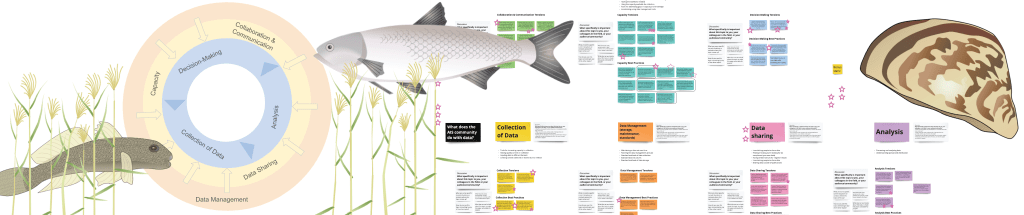
- Detailed synthesis of core tensions and best practices for AIS data work: Following the workshops, PDB synthesized the input from participants, as well as from a survey sent to others in the AIS community, and developed a framework for the core cycle of data work specific to the complexities of AIS in the Midwest. This synthesis included identifying core tensions in categories like decision-making, collection of data, and capacity, as well as best practices used in highly localized ways within the AIS community now. This synthesis will become part of a white paper, to be released by the MBDH, and will also inform future efforts by this group to create infrastructure to support work with data across the Midwest.
“I’ve worked with PDB on multiple projects,” said John MacMullen, Executive Director of the MBDH. “Annemarie and Liz always bring such deep attention and care to their work, making sure that they understand the broader context of the communities of practice they engage with. For the AIS workshop, they showed again that they are empathetic and engaging facilitators who can also provide thoughtful, nuanced analysis of the rich qualitative data that they elicit.”
Images of invasive species in the banner are sourced from the Integration and Application Network (IAN) symbol library, which includes custom made vector symbols designed specifically for enhancing science communication products. This library is supported by the Center for Environmental Science at the University of Maryland.
 Public Design Bureau