Creating a sustainable system for co-creation
With the Health Communication Research Lab (HCRL) and the Health Communication Design Studio (HCDS) / 8 months
In facilitated co-creation processes, collective activities are used to inspire creativity with groups of people. They allow for different perspectives, skills, talents, and experiences to contribute to the creation of a designed outcome. For over 25 years, the Health Communication Research Lab (HCRL) at the Brown School at Washington University in St. Louis has worked directly with community members and partners to identify opportunities, create communication tools, and test those communication tools in the populations they were designed for. These tools have been used to support public health issues such as smoking cessation, cancer communication, and addressing the onset of the COVID-19 pandemic.
The HCRL’s engagement with community members had primarily focused on the prototype testing and evaluation phases of creating something new. They sought to expand that work by bringing in the expertise of people with lived experience earlier in the creative process. To do this, the HCRL team, working closely with their partners at the Health Communication Design Studio (HCDS) at the Sam Fox School of Design & Visual Arts at Washington University in St. Louis, re-focused a project that was already in progress in order to simultaneously build lasting co-creation infrastructure that would allow them to use these approaches on other topics, with other audiences, and in future efforts. The team’s project explored an intersection of topics of interest to partners across the region: teens, mental health, and identity (particularly gender and sexuality). HCRL and HCDS had past success creating conversation cards that assisted people in talking with vaccine-hesitant friends and family about the COVID-19 vaccine, a potentially controversial and conflictual issue. Broaching difficult topics is an experience that might have parallels in supporting teen’s conversations about identity, sexuality, and mental health.
Public Design Bureau worked directly with the HCRL and HCDS teams to collaboratively design and run the co-creation process. In addition to the health communication researchers and designers from HCRL and HCDS, eight panelists were recruited from across the St. Louis region. These panelists included 5 adults who worked closely with LGBTQIA+ teens through their professional practice or volunteer work, and 3 recent high school graduates. This project was funded by the Community Engagement Alliance (CEAL) Against COVID-19 Disparities of the National Institutes of Health (NIH).
Process + Outputs
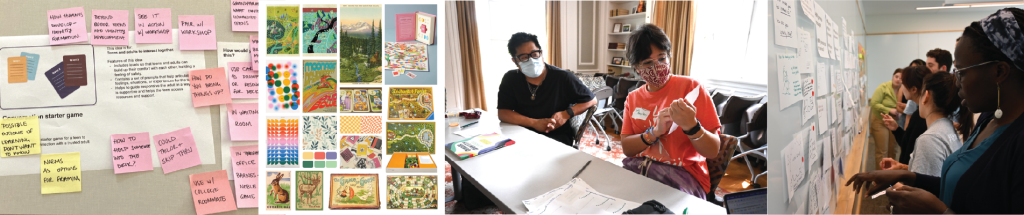
- Collaborative co-design of the process, from initial planning through prototype refinement, working with the planning team made up of HCRL and HCDS researchers and designers. Public Design Bureau created and facilitated process design and reflection sessions. These sessions sought to learn from the experiences HCRL and HCDS had through past projects, spark ideation about new possibilities, and uncover constraints and limitations for co-creation. Some of these sessions were translated into tools for HCRL and HCDS to use for future co-creation planning, such as the Topic Setting & Recruitment Meeting, which includes a protocol for narrowing down to a specific topic for a potential co-creation project.
- Stewardship and coordination of the co-creation team’s activities and intersecting roles, including recruiting, expectation setting, and supporting relationships with the co-creation panelists. This included communicating clear expectations, and hosting sessions and activities that felt worthwhile and fun for the volunteer panelists, as well as supporting the integration of the skills and enthusiasm of HCRL and HCDS team members, so everyone was able to contribute and creatively connect to the project outcomes.
- Creation of co-creation infrastructure, including frameworks, guides, and protocols, documented in a robust toolkit that can serve HCRL and HCDS for future projects that could benefit from co-creation. This toolkit is organized into 7 chapters, following the phases of the design process. In several instances, Public Design Bureau created new frameworks to help guide future conversations, based either on past experiences with co-creation processes or with the lessons learned about the specifics of working with HCRL and HCDS. For example, the “spectrums to consider when deciding if co-creation is a good fit” outlines some of the needed conditions for co-creation to be possible, and when it might be preferred. These tools, accompanied by a robust set of templates and examples, can be adapted for smaller or larger co-creation projects that HCRL and HCDS may consider in the future.
The final document, “A Guide for Co-Creation: Fostering community engagement in health communications,” is available on the HCRL website. The HCRL and HCDS team are moving towards further testing and implementation of the final output from the co-creation team’s work, a colorful, multi-use card game to inspire connection and conversation with teens.
Working with Public Design Bureau was a fantastic experience! Liz and Annemarie are so thoughtful in every aspect of the work that they do, and made our project smoother from start to finish, especially with documentation across all stages. I learned how to implement useful tools and frameworks for any future work that HCDS engages in, as well as how to recreate the co-creation process in an academic research setting and beyond.
Christine Watridge, Program Coordinator at the Health Communication Design Studio
 Public Design Bureau